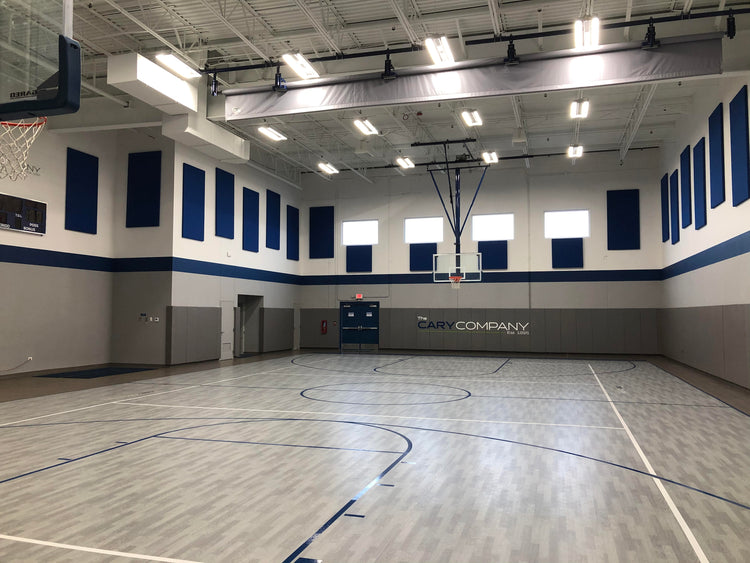
How Do I Reduce Echo in a Room With High or Vaulted Ceilings?
Short answer: High and vaulted ceilings echo because the room holds more air and more bare, hard surface, so sound keeps bouncing before it dies away. Put absorption where the hard surface is: large acoustic panels high on the walls and on the ceiling planes, plus a few at ear height where you sit and talk. In a typical open-concept great room, 2-inch panels on about 15 to 25 percent of the wall and ceiling area usually make conversation and TV dialogue clear again.
Why high ceilings make a room echo
- More air, longer echo. Reverb time grows with room volume: by the Sabine formula in ASP's FAQ (T60 = 0.049 x V / A, in feet), double the volume with the same absorption and the echo lasts about twice as long. A vaulted great room easily holds twice the air of an 8 or 9 ft room.
- More hard surface out of reach. The extra height is drywall, glass and beams that nothing soft touches; furniture and rugs only help the bottom few feet.
- Open plans add more hard surfaces. Kitchen tile, stone counters, cabinets and big windows join in, and with no walls between zones, so the whole space reverberates together.
- The ceiling is often the biggest untreated surface. In a wide room, sound hits the ceiling before a side wall; see wall vs ceiling acoustic panels.
Where panels go in a vaulted or open-concept room, in order
- Upper walls and gable end walls. Usually the largest bare surfaces, clear of furniture and art. One 4 x 8 ft panel covers 32 sq ft, the same as four 2 x 4 ft panels.
- The ceiling planes. Mount panels flush with Z-clips (made for wall or ceiling), or hang them as clouds with the Ceiling Cloud Mounting Kit, flat and parallel to the floor from four points near the corners.
- Ear height where people sit and talk. Panels at the first reflection points around the sofa and TV wall make dialogue clearer.
- The dining and kitchen side. A few panels beside the dining table, or across from the kitchen's hardest surfaces, keep clatter out of the living area.
- Soft furnishings still help. A big rug, upholstered furniture and heavy curtains soften the highs but do not replace panels: do moving blankets or curtains work as acoustic panels?
General rules: the acoustic panel placement guide.
How many panels? A worked example
ASP's room size guide sets a comfort target of 15 to 25 percent of wall plus ceiling area for living rooms. Take a 20 x 24 ft great room with 10 ft side walls and a gable ceiling peaking at 16 ft.
- Long walls: 2 x 24 x 10 = 480 sq ft
- Gable end walls: 2 x (20 x 10 + half of 20 x 6) = 520 sq ft
- Ceiling: two sloped planes, each 24 x about 11.7 ft = about 560 sq ft
- Total: about 1,560 sq ft before windows and doors
- Comfort target, 15 to 25 percent: about 234 to 390 sq ft of panels
Two ways to get there:
- All standard 2 x 4 ft panels (8 sq ft each): 30 to 49 panels. 2-inch 24 x 48 in panels start at $74.99, so roughly $2,250 to $3,675 in panels before shipping.
- A mix of large and standard: six 4 x 8 ft panels (192 sq ft) high on the gable walls or ceiling plus eight 2 x 4 ft panels (64 sq ft) at ear height is 256 sq ft, about 16 percent. Large 48 x 96 in 2-inch panels start at $349.99 and 24 x 48 in at $74.99, so about $2,700 in panels at starting prices. Because the large panels ship freight, the whole order ships freight, one charge quoted separately; free ground shipping does not apply to the standard panels in a mixed order.
Not sure? Send dimensions and photos for a free room analysis, or call (888) 923-5777.
Which panels to use
| Product | What it is | Price (October 2026) | Notes |
|---|---|---|---|
| 2-inch Acoustic Panels | Rigid fiberglass core, wood frame, fabric-wrapped, rated NRC 1.0 (ASTM C423) | 24 x 24 in from $39.99; 24 x 36 in from $59.99; 24 x 48 in from $74.99 | Free ground shipping on orders $349.99 and up when every panel is 24 x 48 in or smaller; if any panel in the order ships freight, the whole order ships freight, one charge quoted separately |
| Large 2-inch Acoustic Panels | Same build, 48 x 48 in up to 48 x 96 in | 24 x 72 in from $159.99; 48 x 48 in and 24 x 96 in from $199.99; 48 x 96 in from $349.99 | Freight, $499.99 flat to the contiguous US, dock to dock; 5-panel minimum, mix and match sizes |
| Custom Acoustic Art Panels | Your photo, logo or artwork on 1, 2 or 4 inch panels, 24 x 24 in up to 48 x 96 in | From $99.99 (24 x 24 x 1 in); 24 x 24 x 2 in is $149.99 | Larger than 24 x 48 in ships freight ($499.99 flat) |
| PET Felt Wall and Ceiling Panels | Recycled PET felt, 9 mm (about 3/8 in), NRC 0.88, Class A (ASTM E84) | 48 x 96 in sheet $249.99 (covers 32 sq ft) | White, Black, Beige, Light Gray, Dark Gray; Navy by special order |
| Ceiling Cloud Mounting Kit | Cable hanging kit, one per panel | $28.75 | Drywall ceilings, joists or exposed structure |
| Z-Clip Mounting Kit | 4 interlocking pairs (8 pieces), screws and drywall anchors | $18.19 | Wall or ceiling; panels lift off to reposition |
Panel prices vary by fabric and color.
Why 2-inch: ASP's broadband panel, the default for living spaces. NRC averages absorption from 250 to 2000 Hz; more in NRC 1.0 explained. Boomy as well as echoey? Add 4-inch panels (24 x 24 in from $69.99).
Making panels look like part of the room
- Match the wall. A fabric close to your wall color makes the panels read as architecture. Order a fabric swatch sample first: the Swatch Sample Kit is $20, credited toward your panel order when you order within 14 days of the swatches arriving.
- Make it art. A printed art panel on a big gable wall can be the focal point.
- Go large. Fewer, bigger panels look more intentional on a tall wall.
- Fire rating. Burch Fabrics Prime Time, the Made in the USA equivalent of Guilford of Maine (a Canadian company) Anchorage and FR701, is Class A under ASTM E-84, as are Guilford of Maine FR701, Anchorage and Whisper. Microsuede and burlap are not fire rated. See fire-rated acoustic fabric.
A real example
One ASP customer's condo, in a former church, has 24 ft vaulted ceilings. Voices got magnified and TV dialogue was hard to follow. Twelve panels, color-matched to the walls, went up, and the customer wrote that they "do exactly what we hoped they would do." (Review on the 2-inch Acoustic Panels page.)
What panels will not do in an open floor plan
Panels cut the echo inside the shared space, so the room is calmer. They will not stop kitchen noise reaching the sofa or sound carrying upstairs through an open loft; that takes walls, doors and construction. See acoustic treatment vs soundproofing.
Questions people ask
Why does my room with vaulted ceilings echo so much?
More air and more bare, hard surface than a standard room, so sound bounces longer before it fades. Furniture and rugs only soften the lower part.
Do I need acoustic panels on a vaulted ceiling?
Not always. The upper walls and ceiling are usually the largest untreated surfaces, so start with large panels high on the walls and add ceiling panels or clouds if echo remains.
How many acoustic panels does a great room with high ceilings need?
Aim for about 15 to 25 percent of total wall and ceiling area. A 20 by 24 ft room with a 16 ft peak needs about 234 to 390 sq ft, roughly 30 to 49 standard 2 by 4 ft panels or fewer large 4 by 8 ft panels.
Will acoustic panels stop kitchen noise from reaching the living room?
No. Panels reduce echo inside the space, so everything is calmer, but they do not block sound traveling between open areas.
Can acoustic panels look like decor?
Yes. Match the fabric to your wall color, use fewer large panels, or print your own photo or artwork on an art panel.