Acoustic Panels FAQ
Real answers from a working acoustic-panel shop. Built in USA. Need help on your specific room? Call (888) 923-5777 or submit a Free Room Analysis.
Looking for a specific fabric or color? See our full Acoustic Fabric Library covering every Burch and Guilford of Maine line we can build panels in, including 48 special-order lines.
Acoustics 101: Do panels actually work?
Do acoustic panels actually work?
Quick answer: Yes - for the problem they solve, which is reducing echo and reverberation inside a room. Real panels (like ours) drop slap echo, clean up speech intelligibility, and tighten the sound of music and instruments. They will NOT block sound from passing through a wall - that is a different problem.
Yes. Real acoustic panels measurably reduce echo and reverberation inside the room they are installed in. You will hear voices clearer, music tighter, and the room will feel calmer. We have hundreds of installed projects across home studios, restaurants, churches, and classrooms - see real customer case studies with before/after video.
What panels DO fix: echo, slap, room-mode boom, speech clarity, listening fatigue, video-call audio quality.
What panels do NOT fix: sound passing THROUGH a wall (that is a soundproofing / wall-construction problem). If your real issue is hearing your neighbors or HVAC noise from another room, panels alone will not solve it - we will tell you so directly. Submit a Free Room Analysis and we will diagnose first.
Related products: 2″ Acoustic Panels · 4″ Acoustic Panels / Bass Traps · Corner Bass Traps
What is the difference between absorption and soundproofing?
Quick answer: Absorption fixes echo INSIDE a room (acoustic panels do this). Soundproofing blocks sound from leaving or entering a room (that requires mass, decoupling, sealed walls, and is a construction job, not a panel job). The two are completely different problems.
This is the single biggest source of confusion in this industry. Get this wrong and you waste money on panels that will not solve your problem.
Absorption = sound energy gets converted to heat inside the panel. Reduces echo, reverberation, and reflection inside the room. Measured in NRC. Fabric-wrapped panels, PET felt, and bass traps do this.
Soundproofing = sound is blocked from passing through a wall, floor, or ceiling. Requires mass (extra drywall), decoupling (resilient channels or staggered studs), and sealing (sealant, door sweeps, putty pads). Measured in STC.
Quick test: can you have a normal conversation in the room but you do not like how it sounds? You need absorption (panels). Can you hear your neighbor through the wall? You need soundproofing (construction work).
If you are not sure which problem you have, submit a Free Room Analysis and we will tell you.
Related products: 2″ Acoustic Panels · 4″ Acoustic Panels / Bass Traps · Corner Bass Traps · Homasote Sound Barrier Panels
What is NRC and what rating should I choose?
Quick answer: NRC is the standard sound-absorption rating. It is a lab-tested average across speech-range frequencies (250-2000 Hz) per ASTM C423, rounded to the nearest 0.05. Higher = better absorption. Our 2″ panels are tested up to NRC 1.0 - the high end of the broadband scale.
NRC stands for Noise Reduction Coefficient. It is the standard way to compare sound-absorption performance between products.
How NRC actually works: labs test the product at 250, 500, 1000, and 2000 Hz, average the absorption coefficients, and round to the nearest 0.05. The result is a number between 0 and ~1.0.
Common NRC ranges:
- NRC 0.10-0.30: hard surfaces (drywall, glass, tile, painted wood) - reflective
- NRC 0.40-0.60: thin foam, fabric panels less than 1″ thick - some help
- NRC 0.80 (Intertek tested per ASTM C423): our 1″ panels - good for high-frequency control
- NRC 0.85-0.95: most 2″ absorbers - strong broadband
- NRC up to 1.0: our 2″ panels - high broadband absorption
NRC is useful for comparing products, but it is not a guarantee that 100% of every frequency in every room is absorbed. Real-room performance depends on placement, coverage area, and what other surfaces are doing.
Related products: 1″ Acoustic Panels · 2″ Acoustic Panels · 4″ Acoustic Panels / Bass Traps
Test report (PDF): 1-Inch Panel ASTM C-423 Acoustic Test Report
Will acoustic panels stop noise from neighbors?
Quick answer: No. Panels reduce echo INSIDE your room - they will not block sound coming through the wall. Sound transmission requires a barrier (mass + decoupling + sealing) at the wall, ceiling, or floor. Adding panels to your side dampens the room but does not solve the transmission problem.
This is the #1 disappointment we work to prevent. If you can hear neighbors / HVAC / equipment through a wall, panels alone will not fix it. The energy is passing through the wall structure itself.
What actually works for transmission problems:
- Add mass to the wall (extra drywall, sometimes mass-loaded vinyl)
- Decouple the wall (resilient channel, staggered studs, double walls)
- Seal every gap (around outlets, ducts, doors, windows)
- Solid-core door + door sweep + jamb seals
- Damping compound between drywall layers
That is a construction job. We do offer Homasote-based barrier panels that can be a component in a properly built STC-rated wall assembly, but they are not a standalone fix.
If your real goal is to take the edge off without doing wall work, treating your side of the wall with absorption helps perceived loudness and improves your own room sound - just do not expect it to silence the neighbor.
Related products: Homasote Sound Barrier Panels
How do your acoustic panels compare to foam?
Quick answer: Real fabric-wrapped panels (NRC up to 1.0 on 2 inch panels) absorb significantly more across the speech and music range than foam (typically NRC 0.40-0.55). Foam looks similar but performs worse, dust easily, and yellow with age. Our panels last decades and look professional.
Foam panels look like acoustic panels but the performance gap is real.
Foam (typical Amazon-style 1-2″ foam): NRC 0.40-0.55. Handles upper frequencies, leaves mid and low-frequency room problems untouched. Yellows in 2-3 years. Catches dust. Often shipped with low-credibility "NRC 0.95" claims that are not lab-tested.
Our 2″ fabric-wrapped panels: NRC up to 1.0 (lab-tested per ASTM C423). Absorbs broadband - speech, instruments, room-mode buildup. Class A flame-spread documentation available for approved assemblies. Made in USA.
If you need real performance for a studio, podcast, restaurant, or commercial space, foam will disappoint you. If you are decorating a closet or treating a budget gaming setup, foam is fine. We will tell you which case you are in.
See our detailed foam vs panel comparison blog for the full breakdown.
Related products: 1″ Acoustic Panels · 2″ Acoustic Panels · 4″ Acoustic Panels / Bass Traps
Do acoustic panels off-gas or emit VOCs?
Quick answer: Our standard fiberglass-core panels use a low-emission binder that is widely used in commercial recording studios, schools, and healthcare facilities. For projects that require zero formaldehyde, our PET felt panels are made from 100% post-consumer recycled polyester - no fiberglass binder, no formaldehyde.
Our standard panels are built with materials chosen to minimize VOC emissions. Our American-made rigid fiberglass core uses a low-emission binder commonly specified in commercial and institutional projects. Like any new building product, allow standard ventilation during and shortly after install.
For zero formaldehyde: our PET felt panels are made from 100% post-consumer recycled polyester. No fiberglass, no formaldehyde, no resin off-gassing, dust-free, naturally hypoallergenic. Well suited for nurseries, classrooms, daycares, pediatric offices, and anyone who is sensitive.
Related products: PET Felt Acoustic Wall & Ceiling Panels · 2″ Acoustic Panels
Are acoustic panels safe for children?
Quick answer: Yes. Our standard fabric-wrapped panels are safe for children's spaces when installed properly - the acoustic core is fully enclosed in commercial-grade fabric. If you prefer a non-fiberglass option, our PET felt panels are 100% post-consumer recycled polyester with no fiberglass and no formaldehyde.
Yes. Our standard panels are safe for kids' spaces when installed correctly. The acoustic core is fully enclosed in commercial-grade fabric so there is no contact with the fill material in normal use, and standard panels carry ASTM E84 Class A flame-spread documentation when built with approved fabric and core options.
Mounting tips for kids' rooms:
- Mount panels above 5-6 feet so they cannot be picked at
- Use proper hardware and confirm secure attachment
- Inspect periodically for damage or loose fabric
If you want a non-fiberglass alternative: PET felt panels - 100% post-consumer recycled polyester, no fiberglass, no formaldehyde, dust-free, naturally hypoallergenic.
Related products: PET Felt Acoustic Wall & Ceiling Panels · 2″ Acoustic Panels
Are DIY acoustic panels as good as professional ones?
Quick answer: For a hobbyist room, well-built DIY panels (rigid mineral wool board + wood frame + acoustically transparent fabric) can perform close to commercial panels. For commercial, school, or fire-rated spaces - no. DIY panels do not carry ASTM E84 Class A documentation, do not have consistent NRC test data, and do not pass code inspection.
Short answer: it depends on the project.
Where DIY can work: hobbyist home studios, gaming rooms, treatment of a single bedroom. If you build with rigid mineral wool or rigid fiberglass + a real wood frame + acoustically transparent fabric, you can hit ~80-90% of commercial-panel performance for materials cost. Plan on a Saturday of work per panel.
Where DIY does not work:
- Commercial / public spaces: code inspectors require ASTM E84 Class A documentation. DIY panels do not have it.
- Schools, churches, healthcare: same - Class A requirement, plus liability for non-tested wall finishes.
- Critical listening: DIY panels rarely have consistent NRC across the build. Two panels you made may absorb differently.
- Aesthetics: the internal wood frame + clean factory wrap is hard to match by hand.
- Custom shapes: our CNC handles circles, hexagons, logos, irregular cuts. DIY does not.
The math: by the time you buy mineral wool, frame lumber, fabric, glue, staples, and burn a weekend, you are within ~20-30% of our 1″ panel cost. For most people, the time savings + Class A documentation + consistent performance is worth the difference. See our 1″ panels as the budget commercial alternative.
Documentation (PDF): Burch Prime Time Flammability Certificate · All spec sheets and test reports
What are room modes and standing waves?
Quick answer: They are low-frequency resonances set by your room dimensions. Thick corner bass traps are the fix, not thin wall panels.
Room modes, also called standing waves, are low-frequency resonances caused by the dimensions of your room. They create boomy spots where bass piles up and dead spots where it disappears, so the low end sounds uneven as you move around. Four inch bass traps in the corners are the primary solution, because they absorb that low-frequency energy before it builds up. No amount of 1 inch or 2 inch panels will fix room modes. You need the thicker traps for that. See How Many Panels Do I Need? for a starter layout.
Do acoustic panels fix flutter echo?
Quick answer: Yes. Even a few panels on one of two parallel walls stops flutter echo.
Flutter echo is the fast ringing you hear when you clap in an empty room. It happens when sound bounces back and forth between two parallel hard surfaces, like two facing walls or a floor and ceiling. Breaking up one of those surfaces is enough to stop it, so even a small amount of treatment on one or both walls eliminates flutter echo. A couple of 1 inch or 2 inch panels on a reflective wall usually clears it up.
Choosing the Right Panel
What thickness should I choose: 1″ vs 2″ vs 4″ acoustic panels?
Quick answer: 2″ is our most popular and the best general-purpose choice (NRC up to 1.0, broadband absorption). 1″ is for upper-frequency control or budget projects (NRC 0.80 (Intertek tested per ASTM C423)). 4″ targets low-mid buildup and bass control. For corner bass control, use corner bass traps.
Pick by what your room needs:
- 1″ panels (NRC 0.80 (Intertek tested per ASTM C423)): high-frequency control - good for taming bright, harsh-sounding rooms or for budget treatment. Will leave low-mid buildup behind.
- 2″ panels (NRC up to 1.0): broadband absorption - the default for studios, podcasts, restaurants, churches, classrooms, home theaters. Strongest "do one thing" choice.
- 4″ panels: deeper absorption into the low-mids. Good for drum rooms, mix rooms, rear walls, and rooms with serious low-frequency buildup.
- Corner bass traps: triangular, mounted in vertical (or horizontal) corners. Specifically targets low-frequency room modes. Pair with 2″ panels.
Default recommendation: if you are not sure, get 2″ panels for the room and add corner bass traps for the lowest-frequency control. That covers ~90% of projects well.
Related products: 1″ Acoustic Panels · 2″ Acoustic Panels · 4″ Acoustic Panels / Bass Traps · Corner Bass Traps
What are bass traps and where do they go?
Quick answer: Bass traps are thicker (typically 4″) panels designed to absorb low-frequency energy - the boomy, muddy buildup in rooms. They go in corners (vertical floor-to-ceiling corners, or where two walls + ceiling meet) because that is where bass energy concentrates. Use corner bass traps for the strongest effect, or 4″ panels on the rear wall.
Low frequencies build up in corners because that is where pressure waves accumulate. Treating corners gets you more bass control per panel than putting the same panel anywhere else in the room.
Two product paths for bass control:
- Corner bass traps - triangular, fits flush in 90-degree corners. Strongest treatment per square foot. Mount in 2-4 vertical corners (floor-to-ceiling).
- 4″ flat panels - thicker absorbers, mount on rear wall behind the listening position or as additional broadband control. Less aggressive bass than corner traps but more visual flexibility.
Minimum studio layout: 4 corner bass traps (2 in front corners, 2 in rear), plus 2″ panels at first reflection points. That is your starter kit.
Related products: Corner Bass Traps · 4″ Acoustic Panels / Bass Traps · 2″ Acoustic Panels
What material are your panels made of? What fabric options do I have?
Quick answer: Rigid fiberglass core (commercial-grade, used in pro recording studios) inside an internal wood frame for a clean, professional finished edge, then wrapped in your choice of 5 fabric options: Burlap, Microsuede, Burch Fabrics Prime Time (our standard, Made in USA, Class A, 36 colors), Guilford of Maine FR701, or Custom Printed (treated as a custom art panel).
Core: commercial-grade rigid fiberglass - the same family of material used in professional recording studios and commercial acoustic specifications. We qualify our rigid fiberglass supply to that same spec regardless of source, so panel performance never changes.
Internal wood frame: every panel is built around an internal wood frame. The frame keeps the panel flat, square, and dimensionally stable, gives the edges a clean professional finish, and makes the panel easier to install. It is what separates a real custom-built acoustic panel from a fabric bag stuffed with insulation.
5 Fabric options:
- Burlap - economical, natural look, broad color range
- Microsuede - softer hand feel, refined look, broad color range
- Burch Fabrics Prime Time (our standard) - Made in USA, commercial-grade, acoustically transparent, Class A fire rated, 36 stocked colors [PDF color card]
- Guilford of Maine FR701 - the legacy spec-and-bid commercial fabric, available on request for projects that require it explicitly
- Custom Printed - your image, photo, or branded design printed onto acoustically transparent fabric (priced as a Custom Acoustic Art Panel)
To see and feel options before ordering: order our $20 swatch sample kit - includes burlap, microsuede swatches, and a 12×12×2″ mini panel. The $20 is credited toward your first order within 14 days of the swatch arriving.
Related products: Swatch Samples · Custom Acoustic Art Panels
Can you match a specific color or Pantone?
Quick answer: Yes - we get close to most Pantone colors using our 36 standard stocked colors. For an EXACT Pantone match, we treat it as a custom printed panel - we print your exact Pantone value onto acoustically transparent fabric. Custom-print pricing applies (not standard fabric pricing).
Two paths for color match:
- Close match from stocked fabric (recommended for most projects): we match against our 36 standard Burch Prime Time colors, plus Guilford of Maine FR701 if your project requires that line specifically. We send swatch confirmation before production. Standard pricing path.
- Exact Pantone match (custom print): if your brand standard requires an EXACT Pantone match - corporate identity panels, lobby signage, stage backdrop - we treat it as a Custom Acoustic Art Panel. We print the exact Pantone value onto acoustically transparent fabric and wrap a real acoustic core. Pricing follows the custom-art-panel structure (size + finish dependent).
Submit a Free Room Analysis with your Pantone reference and we will recommend the right path.
Related products: Custom Acoustic Art Panels · Swatch Samples
Color card (PDF): Download the full Burch Prime Time color card
Can I get custom sizes or custom shapes?
Quick answer: Yes to both. Custom sizes up to 4'×8' single-piece are standard with no size surcharge. Bigger is possible (gets pricey - contact us). For custom shapes - circles, hexagons, logos, irregular cuts, anything you can draw - we cut them on our in-house CNC.
Every panel we ship is custom-built to your specified size, fabric, and finish. There is no surcharge for non-standard rectangular dimensions within our standard production envelope - it is just how we work.
Sizing:
- Single-piece up to 4' × 8' (48″ × 96″): standard production, no size surcharge
- Larger than 4' × 8': yes, we can build it - but pricing climbs because of material yield, handling, and freight. Contact us for a custom quote on oversized single-piece panels
- Multi-panel large installations: we join multiple panels with virtually invisible seams - the cost-effective path for gyms, restaurants, conference rooms, and large feature walls
- Minimum size: typically 12″ on the short side (smaller is possible, ask)
Custom shapes (in-house CNC):
- We cut custom shapes on our in-house CNC - circles, ovals, triangles, hexagons, octagons, arches, irregular curves, logos, custom-cut profiles, just about anything you can draw
- Send us a vector file (DXF, AI, SVG, PDF) or even a hand sketch with dimensions - we will quote it
- Common custom-shape projects: branded logo panels, ceiling clouds in custom shapes, art panels with non-rectangular outlines, architectural feature walls
Tell us what you need. Submit a Free Room Analysis with a sketch or drawing, or call (888) 923-5777 for oversized or complex shape projects.
Related products: 2″ Acoustic Panels · Large 2″ Acoustic Panels · Custom Acoustic Art Panels
Can you print my logo, photo, or artwork on a panel?
Quick answer: Yes - that is exactly what our Custom Acoustic Art Panels are for. Upload an image (logo, photo, painting, branded design) and we print it onto acoustically transparent fabric and wrap a real acoustic core. Same absorption performance + your visual.
Most popular use cases:
- Brand identity panels in lobbies, demo rooms, or feature walls
- Photography or artwork to make a studio or office feel personal
- Restaurant feature walls with food/beverage photography
- Church or auditorium artwork that doubles as acoustic treatment
- Custom backdrops for podcasts, livestreams, and YouTube studios
What we need from you: high-resolution image (300 DPI at final panel size, RGB or CMYK), confirmation you have the rights to print it (your own work, licensed image, or rights-cleared source).
Pricing: see Custom Acoustic Art Panels for current pricing - varies by size and finish.
Related products: Custom Acoustic Art Panels
What is the difference between PET felt panels and fabric-wrapped fiberglass?
Quick answer: PET felt: 100% post-consumer recycled polyester, no fiberglass, no formaldehyde, modern look, NRC ~0.88. Fabric-wrapped fiberglass: best broadband absorption (NRC up to 1.0 on 2 inch panels), 5 fabric options including custom print. PET felt is great for offices, classrooms, and people who want eco/no-fiberglass; fabric-wrapped is the studio/restaurant/full-treatment standard.
PET felt panels (drop-in tiles or wall panels):
- Made from 100% post-consumer recycled polyester
- No fiberglass, no formaldehyde, dust-free, naturally hypoallergenic
- NRC ~0.88 (very strong)
- Modern, clean look - well suited for offices, classrooms, daycares, modern interiors
- Drop-in ceiling sizes: 12″×12″, 24″×24″, 24″×48″
Fabric-wrapped fiberglass panels:
- American-made rigid fiberglass core, 5 fabric options (Burlap, Microsuede, Burch, Guilford, Custom Printed)
- NRC up to 1.0 on 2 inch panels - highest broadband absorption
- Class A fire rated documentation available for approved assemblies
- Custom sizes any dimension up to 4'×8'
- Standard for studios, restaurants, churches, performance venues
Not sure which fits? Submit a Free Room Analysis and we will recommend.
Related products: PET Felt Acoustic Wall & Ceiling Panels · 2″ Acoustic Panels · Custom Acoustic Art Panels
Do you make ceiling tiles for drop ceilings?
Quick answer: Yes - both fiberglass-core and PET felt drop-in ceiling tiles. Standard 24″×24″ and 24″×48″ sizes that drop into a standard T-bar grid.
Two ceiling tile options:
- Acoustic Ceiling Tiles - fiberglass core, standard drop-in sizes, strong absorption.
- PET Felt Wall & Ceiling Panels - 100% recycled polyester, no fiberglass, no formaldehyde. Modern look, strong absorption.
Both fit a standard 15/16″ T-bar grid. For other ceiling types (drywall, concrete, exposed structure), see our wall-mount panels and ceiling cloud options.
Related products: Acoustic Ceiling Tiles · PET Felt Acoustic Wall & Ceiling Panels
Do you make outdoor acoustic panels?
Quick answer: No - our products are indoor solutions. True outdoor noise barriers require weather-rated mass barriers and structural construction, not fabric-wrapped panels. If you have an outdoor noise problem (HVAC, traffic, neighbor pool equipment, pickleball court), tell us about the application and we will tell you whether our products fit.
Fabric-wrapped panels are not weather-rated. Sun, rain, freeze-thaw, and UV will break down the fabric and core within months.
What actually works for outdoor noise: mass-loaded barrier walls (line of sight + mass), enclosures around the noise source, and properly sealed structural construction. Different industry, different products.
If your "outdoor" project is actually a covered patio, semi-enclosed pavilion, or three-sided structure with a roof, we may be able to help with weather-protected fabric-wrapped or PET felt panels. Tell us the situation - submit a Free Room Analysis with photos.
What is the difference between fiberglass, mineral wool, and rockwool cores?
Quick answer: Fiberglass (rigid 3 lb/sqft - 6 lb/sqft) is our standard - higher NRC at lower weight, easier to ship, the spec material in pro studios. Mineral wool / rockwool boards are denser - slightly better at low frequencies but heavier and harder to mount on ceilings. Both are technically fine; the spec difference matters more than the brand.
This is one of the most common technical questions from spec writers and DIY-curious buyers.
Rigid fiberglass (our standard core):
- 3 lb/sqft - 6 lb/sqft density typical
- NRC up to 1.0 in 2″ thickness
- Lighter weight - critical for ceiling clouds and large panels
- Standard in pro recording studios and commercial AV
- Sourced from multiple approved fiberglass suppliers, spec-equivalent and interchangeable without changing performance
Mineral wool / rockwool (a denser commercial board):
- Higher density (typically 8 lb/sqft+)
- Slightly better low-frequency absorption per inch of thickness
- Heavier - harder to mount overhead, more shipping cost
- Common in DIY builds because it is available at home stores
Which is right: for 95% of projects, our standard rigid fiberglass core is the better engineering choice (better NRC per lb, better Class A documentation, easier to install). If your project spec calls out mineral wool specifically, call us to talk through the requirement - our standard fiberglass assemblies carry the Class A documentation most specs are actually after.
What is the difference between diffusion and absorption?
Quick answer: Absorption converts sound to heat (panels do this) - reduces echo and reverb. Diffusion scatters sound randomly (diffusers do this) - keeps the room feeling "alive" without creating reflections. Most rooms benefit from absorption everywhere except the rear wall, where diffusion preserves spatial sense without comb-filtering.
The two ways to control sound in a room:
Absorption:
- Sound energy hits the panel and converts to heat inside the porous material
- Reduces echo, slap, reverb, and total room energy
- Measured by NRC
- Our fabric-wrapped panels, PET felt panels, and bass traps all do this
Diffusion:
- Sound hits the diffuser and scatters in many directions instead of reflecting in one direction
- Reduces flutter echo and comb-filtering without removing room energy
- Keeps the room feeling "alive" rather than "dead"
- Our quadratic diffusers do this
Where to use which:
- Side walls (first reflections): absorption - kill the early reflection cleanly
- Front wall (behind speakers): absorption - prevent comb-filtering with the source
- Rear wall (behind listener): diffusion or 50/50 mix - preserves stereo depth without flutter
- Corners: absorption (bass traps) - corners are bass-build-up zones, not reflection zones
- Ceiling: typically absorption - cloud above the listening position
Most home studios get over-absorbed. If your room sounds dead and tiring, swap some panels for diffusers on the rear wall.
What artwork files do you need for custom printed acoustic art panels?
Quick answer: Vector files preferred (AI, EPS, SVG, PDF) for logos and graphic art. High-resolution raster (300 DPI at final panel size) for photography. RGB or CMYK both work. We need rights confirmation - your own image, licensed image, or rights-cleared source. We do not print copyrighted artwork without usage rights on file.
What we accept:
- Vector (preferred for logos/graphics): AI, EPS, SVG, PDF - these scale to any size with no loss of quality
- Raster (preferred for photos): JPEG, PNG, TIFF at 300 DPI minimum at the FINAL panel size. A 4″×8″ panel needs an image that is 14,400 × 28,800 pixels to print without pixelation
- Color modes: RGB or CMYK both work - we color-manage the print
- For Pantone-exact match: include the Pantone reference number in the file or order notes
What we need from you:
- The high-resolution file (upload via our order page or send a download link)
- The final panel size and orientation
- Rights confirmation - your own image, licensed image (proof on file), or public-domain source
We do not print: copyrighted art without rights, celebrity likenesses without releases, brand logos you do not own, or images we cannot verify a rights chain for. For commercial / sports / music / movie artwork, get written clearance before submitting.
Proof process: we send you a digital proof of the print layout before production. You confirm before we cut any fabric.
Order Custom Acoustic Art Panels | Quote a custom-print project
Do the drop-in ceiling tiles come in colors?
Quick answer: The 2x2 and 2x4 drop-in ceiling tiles come in white only. Other colors are a special order: tell us the color and quantity and the team will confirm lead time and price before you commit.
For color on the ceiling without a special order, the PET felt ceiling panels come in white, black, beige, light gray and dark gray, with navy as a special order. The drop-in tiles are 1 inch fiberglass for a standard T-bar grid, so they replace a plain white grid tile with one that absorbs.
How Many Panels Do I Need?
How many acoustic panels do I need for my room?
Quick answer: For most rooms: 20-30% wall coverage with 2″ panels handles general echo. Studios and home theaters: 30-45%. Critical listening / mix rooms: 45-60%. Use our Panel Calculator for a tailored estimate, or submit a Free Room Analysis for a written recommendation.
Coverage % is the cleanest way to think about this. Take your total wall + ceiling square footage, multiply by your target coverage, that gives you total panel sqft.
Coverage targets by use case:
- Comfort (general echo / restaurants / offices / classrooms): 15-25% - just enough to make speech clear and the room feel calm.
- Reference (home studios, podcasts, video, livestream): 25-35% - cleaner takes, less listening fatigue, predictable sound.
- Studio (mix rooms, critical listening, drum rooms): 35-50%+ with corner bass traps - low room signature, accurate decisions.
Worked example: 12×14 home studio (10' ceiling, 14×12=168sqft floor, walls=520sqft). Reference target 30% = 156sqft of panel coverage. That is roughly 13 panels at 2'×4' each. Plus 4 corner bass traps. Roughly $700-1100 in panels.
Best move: use the Panel Calculator for a tailored estimate, then submit a Free Room Analysis with photos for a written quote.
Related products: 2″ Acoustic Panels · 4″ Acoustic Panels / Bass Traps · Corner Bass Traps
Where should I place panels for best results?
Quick answer: Treat first reflection points first (the spots where sound bounces off walls and ceiling between the source and your ears). Then add corner bass traps. Then fill in remaining wall coverage to hit your target %. Avoid putting panels on every surface - some reflection is good.
Priority order for placement:
- First reflection points on side walls (trace the path: source → wall → your ear; mirror trick: have someone slide a small mirror along the wall - where you can see the speaker, that is the spot). Also ceiling above and slightly in front of your listening position.
- Corners - vertical corners floor-to-ceiling, especially behind the listening position. Use corner bass traps.
- Rear wall behind the listener - 4″ panels here tighten low-mids.
- Front wall behind speakers - 2″ panels reduce comb-filtering and give a tighter image.
- Fill remaining surfaces until you hit your coverage target.
Avoid: covering 100% of every surface - some reflection helps the room sound natural and "alive." Over-treatment makes rooms sound dead and tiring.
Related products: 2″ Acoustic Panels · 4″ Acoustic Panels / Bass Traps · Corner Bass Traps
Do I need bass traps or just regular panels?
Quick answer: If your room has bass buildup, boomy / muddy low end, or you do critical listening (mixing, mastering, home theater), yes - corner bass traps are worth their cost. If your room is just echoey and you mostly need speech clarity, regular 2″ panels alone are enough.
Add bass traps when:
- You can hear obvious low-frequency boom or "thump" in the room
- You are doing critical listening (mixing, mastering, hifi listening)
- You are setting up a drum room, recording booth, or home theater
- Your room is rectangular and small (under ~200sqft)
Skip bass traps when:
- Treating an office, classroom, restaurant, or general-purpose space
- Your problem is high-frequency echo and speech clarity
- Budget is tight - 2″ panels first, traps later as upgrade
Default studio kit: 4 corner bass traps + 8-12 2″ panels.
Related products: Corner Bass Traps · 4″ Acoustic Panels / Bass Traps · 2″ Acoustic Panels
Can a room have too many panels?
Quick answer: Yes. Over-treated rooms sound dead, lifeless, and fatiguing - voices feel flat, music loses sense of space. For most rooms, 30-50% coverage is the sweet spot. Beyond ~60% coverage you start losing the room's natural character.
The goal is "controlled" not "absorbed." Some reflection is what makes a room sound natural.
Signs of over-treatment:
- Voices sound flat and "papery"
- The room feels uncomfortable to talk in
- Music loses sense of stereo width or depth
- You hear your own breathing too clearly
Fix: remove some panels (rotate, do not throw away). Or add diffusers - quadratic diffusers scatter sound rather than absorb, which restores liveliness while keeping the room controlled.
How do I calculate reverb time for a room?
Quick answer: Use Sabine's formula: T60 = 0.161 × V / A, where V is room volume in cubic meters and A is total absorption in sabins. The faster way: target reverb time (RT60) of 0.3-0.5 seconds for studios, 0.6-0.8 for classrooms, 1.0-1.5 for performance spaces, and back-calculate panel sqft needed. Or use our Panel Calculator and tell us your space type - we will give you a target.
Reverb time (RT60) is the time it takes for a sound to decay 60 dB after the source stops. It is the cleanest single number for room acoustic quality.
Target RT60 by space type:
- Critical mix room: 0.25-0.35s
- Recording studio control room: 0.30-0.45s
- Home theater: 0.35-0.50s
- Live recording space: 0.50-0.80s
- Classroom (good speech intelligibility): 0.60-0.80s
- Restaurant (lively but comfortable): 0.80-1.20s
- Concert hall / sanctuary: 1.50-2.20s
Sabine's formula: T60 = 0.161 × V / A (metric: V in m³, A in sabins) or T60 = 0.049 × V / A (imperial: V in ft³, A in sabins).
Worked example: 12×14×9 ft room = 1,512 ft³. Untreated, A is roughly 50 sabins (drywall, glass, hard floor). RT60 ≈ 0.049 × 1512 / 50 = 1.48s, too live for studio work. To hit RT60 = 0.4s, you need A = 185 sabins. Each 2'×4' 2″ panel adds ~6.5 sabins (NRC ~0.95, 8 sqft, accounting for mounting). So ~21 panels needed.
Or just use our Panel Calculator and we do the math.
Installation
How do I install acoustic panels?
Quick answer: Two main options: Z-clips for a clean flush-mount on drywall, masonry, or concrete; or 3M Command Strips for a renter-friendly no-drilling install. We include illustrated install instructions with every order. For oversized panels or ceiling clouds, Z-clips are the standard.
Z-clip system (our recommended hardware - Z-Clip Installation Kit):
- Two interlocking aluminum cleats - one mounts to the wall, the matching cleat is on the panel back
- Panel hooks onto the wall cleat - flush, secure, removable
- Works on drywall, masonry, concrete, and most wall types with appropriate anchors
- Standard for large panels, ceiling clouds, and any install where you want clean alignment
3M Command Strips (renter-friendly, no drilling):
- No holes, removable, leaves no marks when you move out
- Best for lighter panels (1″ PET felt or 1″ fabric-wrapped, smaller sizes)
- Use multiple strips per panel rated for the panel's actual weight
- Clean wall with rubbing alcohol before mounting; press firmly for 30 seconds; wait 1 hour before letting go
By wall type:
- Drywall: Z-clips with hollow-wall anchors, or hit a stud where possible
- Concrete / masonry: Z-clips with Tapcon or sleeve anchors
- Renters / dorms: Command Strips for lighter panels
Download the full Acoustic Panel Installation Guide (PDF). We also include illustrated install instructions with every order. For oversized panels, ceiling clouds, or unusual wall conditions, call (888) 923-5777 and we will recommend the right hardware.
Related products: Z-Clip Installation Kit · 2″ Acoustic Panels
How do I install panels on the ceiling?
Quick answer: Ceiling clouds use Z-clip mounting hardware or eye-bolt + cable kits to suspend panels below the ceiling. Drop-in ceiling tiles (24″×24″ or 24″×48″) just drop into a standard T-bar grid. Tell us your ceiling type and we will recommend the right hardware.
Drywall ceilings (clouds): Z-clip kits or hanging-cable kits. Panels hang ~2-6″ below the ceiling for a "cloud" look that improves first-reflection control. Use anchors rated for panel weight (lock into joists where possible).
Drop ceilings (T-bar grid): use Acoustic Ceiling Tiles or PET Felt Wall & Ceiling Panels - drop right into the grid, no extra hardware needed.
Exposed structure (warehouse / loft / industrial): typically hung with cable kits anchored to joists or beams. We can quote the right hardware once we know the structure.
Related products: Z-Clip Installation Kit · Acoustic Ceiling Tiles · PET Felt Acoustic Wall & Ceiling Panels
Can I install acoustic panels as a renter?
Quick answer: Yes - use 3M Command Strips. Lighter 1″ panels and PET felt panels are the best fit for Command Strips. No drilling, removable, no damage when you move out. Larger or heavier panels may need Z-clips or Z-clips.
Command Strips work well for panels up to ~5-7 lbs each. That covers:
- 1″ fabric-wrapped panels (most sizes)
- PET felt panels (drop-in or wall-mount)
- 2″ fabric-wrapped panels in smaller sizes (24″×24″, 24″×36″)
Tips for renter installs:
- Use multiple strips per panel - rated for actual panel weight
- Clean wall with rubbing alcohol before mounting (Command Strip standard)
- Press firmly for 30 seconds, then wait 1 hour before letting go
- Larger 2″ or 4″ panels: lean against the wall on a small ledge or use ground-standing frames
Related products: 1″ Acoustic Panels · PET Felt Acoustic Wall & Ceiling Panels · 2″ Acoustic Panels
Where do bass traps go and how do I mount them?
Quick answer: Vertical floor-to-ceiling corners (especially front and rear corners). They mount with the same Z-clip hardware as flat panels, but rotated to span the corner. 4 corner traps is the standard studio starter kit.
Standard placement:
- 2 traps in front corners (behind the speakers / source)
- 2 traps in rear corners (behind the listening position)
- For aggressive treatment: add 2 in the front-floor or rear-floor corner
Mounting: Z-clips work for triangular corner traps - mount one cleat on each wall meeting the corner, panel hooks onto both. For drywall corners with no stud backing, use hollow-wall anchors rated for panel weight (typically 5-10 lbs per trap).
Related products: Corner Bass Traps · 4″ Acoustic Panels / Bass Traps
What spacing should I use between panels?
Quick answer: For visual rhythm, 4-12″ gaps between panels look clean. For acoustic performance, panel spacing barely matters - what matters is total coverage area. So space them to look good and let the room's coverage % do the acoustic work.
Spacing tips:
- Gallery layouts: 4-8″ gaps between panels feels intentional
- Grid layouts (commercial): 8-16″ gaps for a tile-like rhythm
- Tight cluster (rear wall behind listener): touching or near-touching is fine
- Avoid covering 100% of a single wall edge-to-edge - leaves no visual breathing room
Pricing & Buying
How much do acoustic panels cost?
Quick answer: Pricing depends on size, thickness, and fabric. For exact, current pricing, see the live product pages. We do not freeze a per-sqft number in the FAQ because real pricing tracks our cost inputs. Free ground shipping on orders $349.99+ for panels 24″×48″ and smaller. Panels larger than that ship freight, dock to dock.
We custom-build every panel, so the price depends on size, thickness (1″ / 2″ / 4″), and fabric.
For current, exact pricing, see live product pages:
- 1″ Acoustic Panels (NRC 0.80 (Intertek tested per ASTM C423))
- 2″ Acoustic Panels (NRC up to 1.0)
- 4″ Acoustic Panels / Bass Traps
- Corner Bass Traps
- PET Felt Acoustic Wall & Ceiling Panels
- Custom Acoustic Art Panels
- Homasote Sound Barrier Panels
Use our Panel Calculator to estimate panel count, then submit a Free Room Analysis for a written quote on your specific space.
Related products: 2″ Acoustic Panels · 4″ Acoustic Panels / Bass Traps · Corner Bass Traps
Can I get a formal quote?
Quick answer: Yes. Submit a Free Room Analysis with your room dimensions, target install date, fabric color preference, and any project details (commercial / institutional / residential). We will reply with a written, project-specific quote.
Free Room Analysis is the fastest path to a real quote. Tell us:
- Room dimensions (length × width × ceiling height)
- What you are trying to fix (echo, podcast quality, mix room, restaurant noise, etc.)
- Surface materials (drywall, concrete, glass, wood)
- Fabric color preference (or "I am open to recommendations")
- Target install date
- Photos of the room (especially helpful for commercial work)
For larger commercial / institutional / contractor / integrator projects, we provide a detailed proposal with line-item pricing and Class A documentation as needed. Call (888) 923-5777 to talk through bigger jobs.
Do you offer financing?
Quick answer: Yes - Shop Pay Installments and Affirm are available at checkout for qualifying orders. Split into 4 interest-free payments (Shop Pay) or longer-term financing (Affirm). Net terms are not offered; orders are paid in full before production begins.
At checkout:
- Shop Pay Installments - 4 interest-free payments every 2 weeks (subject to eligibility)
- Affirm - longer-term financing (3, 6, or 12 months) on qualifying orders, subject to credit approval
- Major credit cards, Apple Pay, Google Pay, PayPal also accepted
Commercial accounts: orders are paid in full before production begins. Purchase orders and net terms are not offered. Tax-exempt orders are handled for schools, churches, government buyers, contractors, and integrators. Shop Pay Installments or Affirm is available at checkout if you want to spread the cost.
Do you accept tax-exempt orders?
Quick answer: Yes - schools, churches, non-profits, and government entities. Upload your tax-exempt certificate at checkout, or send it with your Free Room Analysis submission.
Tax-exempt status removes sales tax from the order. We accept:
- Schools and educational institutions
- Churches and religious organizations
- Government entities (federal, state, local)
- 501(c)(3) non-profits
Send your certificate via the Free Room Analysis form, or upload it at checkout. We will validate before shipping.
Do you offer bulk or commercial pricing?
Quick answer: For real commercial / education / integrator / wholesale projects, we quote project-specifically. Submit a Free Room Analysis with quantity, room dimensions, and target install date and we will reply with a written quote.
We custom-build every panel, so our standard pricing already reflects strong value relative to retail acoustic brands. For genuine commercial work we quote each project individually.
Real-project examples we quote regularly:
- School / church / classroom installs (10+ rooms or 50+ panels)
- Restaurant chains and hospitality rollouts
- AV integrator and contractor pull-through
- Government and military projects
- Architect / interior designer specifications
Call (888) 923-5777 or submit a Free Room Analysis with project scope. We do not publish standing volume tiers because every project is different.
Can I order a sample first?
Quick answer: Yes - the $20 swatch sample kit includes a Burch Prime Time color sample card showing every Burch color, plus burlap and microsuede fabric swatches plus one 12×12×2″ mini panel (NRC 1.0 rated). The $20 is credited toward your first order if placed within 14 days of the swatch arriving. We do not mail free swatches.
Order Swatch Samples to confirm color, texture, and finish before placing a larger order.
What is in the kit:
- Burlap fabric swatches
- Microsuede fabric swatches
- One 12×12×2″ mini panel - real construction, real edge detail, NRC 1.0 rated
Why $20: the kit costs us money to build and ship. The $20 is credited back when you place your first real order within 14 days of the swatch arriving - so you only "pay" for the kit if you do not become a customer.
For a much wider color range (36 Burch Prime Time colors), submit a Free Room Analysis and we will mail printed color cards along with project recommendations.
Related products: Swatch Samples
Color card (PDF): Download the full Burch Prime Time color card to browse all 36 colors before you order the physical kit.
Is there a minimum order?
Quick answer: No minimum order on our standard product pages - you can buy a single panel. For custom commercial / wholesale projects, we work with project teams of any size; submit a Free Room Analysis with your scope. For freight shipping (panels larger than 24″×48″), there is a 5-piece minimum because freight is priced per-pallet.
Standard ordering: no minimum. Order a single 1″ panel, a sample kit, a 4″ bass trap, whatever you need. Most of our orders are 4-20 panels for home studios and small commercial.
Freight orders (panels larger than 24″×48″ that ship LTL on a pallet): 5-piece minimum. Freight is priced per-pallet, so 1-piece freight is cost-prohibitive. Customers can mix panel sizes within the freight order.
Custom commercial / wholesale projects: no minimum on the customer side - we just quote each project to its scope. Smallest commercial we have done: 4 custom-printed art panels for a single restaurant feature wall. Largest: 800+ panels for a multi-building school district install.
For a custom project quote, submit a Free Room Analysis or call (888) 923-5777.
Do you offer bulk or wholesale pricing?
Every panel is priced per item as listed. For real commercial, education, AV integrator, and wholesale projects we quote project-specifically. Submit a Free Room Analysis with quantity, room dimensions, and target install date, and we will reply with a written quote. For larger or recurring volume, call (888) 923-5777 to talk to a human.
Do you have active discount codes?
We do not run sales, discount codes, or volume-based pricing. Every panel is priced per item on its product page. For a commercial or wholesale project quote, call 888-923-5777. For a custom-quoted project price, call (888) 923-5777 or submit a Free Room Analysis.
Do you accept purchase orders or net terms?
Quick answer: We handle tax-exempt orders for businesses, schools, and government buyers, but we do not offer purchase orders or net terms.
We handle tax-exempt orders for businesses, schools, and government buyers, but we do not offer purchase orders or net terms. Orders are paid in full up front by card, ACH, wire or Zelle, or you can finance through Shop Pay Installments or Affirm at checkout.
Shipping, Lead Times & Returns
What are your lead times?
Quick answer: Lead time depends on current shop workload. Every panel is built to order. Call (888) 923-5777 with your deadline. We do not promise specific dates without shop confirmation.
Production:
- Standard sizes: built to order, current window confirmed by phone
- Custom sizes / printed panels: built to order after proof approval, current window confirmed by phone
- Large commercial projects: lead time is quoted per project based on current shop workload - ask for a current ETA when you submit a Free Room Analysis
- Rush: available - call to confirm what is doable on your timeline; expedited fees may apply
Note on timing: we will not promise a specific ship date until the shop confirms it. If you have a hard deadline, tell us early - we will flag it as a rush so production can prioritize.
What does shipping cost? When is it free?
Quick answer: Free ground shipping on orders $349.99+ for panels 24″×48″ and smaller (continental US). Panels larger than 24″×48″ ship freight - quoted at checkout based on size and destination. Carriers: UPS or FedEx for parcel; freight/LTL on pallets for oversized.
Free Ground Shipping: orders $349.99+ on panels 24″×48″ and smaller, continental US.
Panels larger than 24″×48″ ship freight - they exceed parcel-carrier dimensions and require freight/LTL on a pallet. Freight is quoted separately based on size and destination.
Carriers:
- Orders with panels 24″×48″ or smaller: UPS or FedEx Ground
- Any order containing panels larger than 24″×48″: freight/LTL on pallets, curbside delivery (liftgate available on request)
- International (Canada): FedEx International or freight - duties/taxes paid by customer on delivery
Transit time: typically several business days ground in the continental US, depending on zone. Tracking is emailed when the order ships - please do not schedule install until you have tracking.
Do you ship to Canada or internationally?
Quick answer: Yes - we ship to Canada and select international destinations. International shipping is quoted on a per-order basis (size + destination). Customer pays duties, taxes, and import fees on delivery. PET felt panels often clear customs faster than fiberglass.
For Canadian orders:
- Most ship via FedEx International or freight
- Transit typically runs longer than domestic ground
- Customs fees paid by customer on delivery
- Free shipping offer applies to US orders only
For other international destinations, contact us first - some countries have import restrictions on fiberglass products. PET felt panels often ship internationally easier.
Do you offer freight shipping for large orders?
Quick answer: Yes - panels 48″×48″ and larger ship freight on pallets. 5-piece minimum for freight orders (can mix sizes). Standard service is curbside delivery; liftgate available on request.
Freight basics:
- Required for panels 48″×48″ and larger
- Minimum 5 pieces (can mix sizes within the order)
- Curbside delivery standard - driver brings the pallet to the curb
- Liftgate available for additional charge
- Inside delivery and white-glove available - quote separately
- Commercial addresses get better rates than residential
What you need: reachable phone number, dock or forklift if declining liftgate, person on-site to receive and inspect.
Related products: Large 2″ Acoustic Panels
Can I return acoustic panels?
Quick answer: Stock items follow the standard return window per our Refund Policy (read for exact terms). Custom-built panels (made-to-order to your size, fabric, or print) are not returnable, per our Refund Policy, because we cannot resell them. Items that arrive damaged, defective or wrong are covered: note any shipping damage on the delivery receipt and contact us immediately.
Stock items: see our Refund Policy for the standard return window, condition requirements, and restocking details.
Custom-built panels (made-to-order): not returnable, per our Refund Policy. Custom dimensions, custom fabric, or custom-printed panels cannot be resold to another customer.
Damage or our error (shipping damage, manufacturing defect, wrong size shipped): covered. Note any shipping damage on the delivery receipt before you sign, so your claim is protected. Photograph the damage on delivery and contact us immediately. We will replace it.
Before you order, do this: submit a Free Room Analysis with room dimensions and the actual problem. We will tell you if panels will fix it BEFORE you commit. If the real problem is sound transmission (you can hear neighbors / equipment / HVAC through walls), panels alone will not solve it - we will say so directly and recommend a different approach.
What if my panels arrive damaged?
Quick answer: Note the damage on the delivery receipt before you accept it, send us photos immediately through our contact form, and keep all packaging. We replace it free.
Inspect your shipment before you accept it. If anything looks damaged, note the damage on the delivery receipt before you sign for it, take a few photos of the box and the panels, and submit them with your order number through our contact us page immediately. Keep the damaged panels and all packaging until your claim is resolved, since the carrier may need to inspect them. We file the carrier claim and reprint your panels at no cost to you. A delivery receipt signed clean with no damage noted can void the carrier claim, so the note at delivery matters.
Can fabric be replaced if a panel is damaged?
Quick answer: Case by case. We do not run a re-wrap service for panels we did not damage - it is faster and cleaner to order a replacement panel that matches your existing size, fabric, and finish. If a fault is on us (shipping damage, manufacturing defect), we cover replacement.
Re-wrap costs (ship back, strip, re-source matching fabric, re-wrap, ship out) usually exceed the cost of a fresh custom-built replacement panel. The fresh panel ships faster and looks better.
Default recommendation: order a replacement panel matched to your original spec.
Exception: if a panel is large, oddly-sized, or one of a kind, reach out and we will look at re-wrap on a case-by-case basis. Call (888) 923-5777.
Do you offer express shipping?
Most orders ship via standard ground freight, which is what our free-shipping promotion covers (free ground shipping on orders $349.99+ in the continental U.S.). Because every panel is custom built to order, the dominant factor in delivery date is build lead time, not transit speed. If you have a hard install date, call (888) 923-5777 before ordering so we can confirm the schedule and discuss expedited carrier options where they are actually useful.
Do you ship internationally?
Yes - we ship to Canada and to select international destinations. International orders are quoted on a per-order basis because rates depend on size, weight, and destination. The customer pays duties, taxes, and import fees on delivery. PET felt panels generally clear customs faster than fiberglass-core panels. For an international shipping quote, call (888) 923-5777 or submit a Free Room Analysis with the delivery address.
Can I cancel my order after I place it?
Quick answer: Custom and made-to-order orders cannot be canceled once payment is received. Stock items follow our Refund Policy.
Custom and made-to-order orders cannot be canceled once payment is received. Stock items follow our Refund Policy. Contact us right away if you need to make a change.
How do I check my order status or get a tracking number?
Quick answer: Contact us with your order number and we will send your current status and tracking.
Contact us with your order number and we will send your current status and tracking. Because every panel is built to order, tracking goes out when your order ships, not at the time of purchase.
Do you offer a rush option for tight deadlines?
Quick answer: Yes. If your order is mission critical, we offer a rush option - contact us before you order.
Yes. If your order is mission critical, we offer a rush option. Contact us before you order and we will tell you what is possible for your timeline.
Can you ship on my company's freight account or blind ship to my customer?
Quick answer: Yes. For business orders we can ship on your freight account and handle blind shipments.
Yes. For business orders we can ship on your freight account and handle blind shipments. Send us your account details and ship-to information and we will set it up.
Fire Ratings, Codes & Specs
Are your panels Class A fire rated?
Quick answer: Yes - our standard fiberglass-core panels with approved Class A fabric options are available with ASTM E84 Class A flame-spread documentation. Fire rating depends on the specific assembly (fabric + core + finish), so commercial projects should request the applicable test documentation before ordering.
Class A is the strictest commercial flame-spread tier under ASTM E84:
- Flame Spread Index 0-25
- Smoke Developed Index 0-450
What we provide: ASTM E84 Class A test documentation for our standard Burch Fabrics Prime Time and Guilford of Maine FR701 fabrics over our standard American-made rigid fiberglass core.
Important: Class A applies to specific tested assemblies. If you specify a non-standard fabric, custom core, custom finish, or unusual configuration, ask us to confirm Class A documentation BEFORE ordering. Burlap and microsuede are NOT Class A by default.
For commercial projects: request the applicable test documentation when you submit your Free Room Analysis.
Do panels meet building codes for commercial use?
Quick answer: Class A is commonly required or specified for many commercial, school, restaurant, healthcare, and public-space projects. Final requirements depend on the specific project, location, occupancy, and the local code authority. Class A documentation is available for our standard approved assemblies.
"Required by code" is often more nuanced than "all commercial buildings need Class A." Final requirements depend on:
- Project type and occupancy classification (assembly, business, educational, healthcare, etc.)
- Location and applicable code (IBC, NFPA, state/local amendments)
- Wall vs ceiling location, sprinklering, square footage, and other factors
- The Authority Having Jurisdiction (your local code official)
For commercial projects, we provide ASTM E84 Class A documentation for approved panel assemblies. If your project needs additional fire-rating documentation (specific test reports, signed compliance letters, etc.), tell us up front.
Are CAD files / spec sheets available?
Quick answer: Yes - for commercial / architect / integrator specifications, we can provide CAD files, dimensional spec sheets, and ASTM test documentation. Submit a Free Room Analysis or call (888) 923-5777 with your project details.
Available right now (PDFs):
- Burch Prime Time Flammability Certificate
- 1-Inch Panel Acoustic Test Report (ASTM C-423)
- 2-Inch Acoustical Wall Panel Spec Sheet
- Homasote 440 SoundBarrier 3-Part Architect Specifications
- Burch Prime Time Color Card
- Full spec sheets & test reports library
Other spec materials available on request:
- Dimensional drawings (DWG / DXF / PDF)
- ASTM C423 sound-absorption test reports
- ASTM E84 flame-spread documentation (for approved assemblies)
- Material safety data sheets
- Sustainability / environmental certifications
- 3-part architect specifications (CSI format)
Tell us what your spec needs in your Free Room Analysis submission and we will pull together the package.
Use Cases: What Works for Your Space
What works for a home recording studio?
Quick answer: 4 corner bass traps (vertical corners) + 8-12 2″ panels at first reflection points and on the rear wall + 1-2 4″ panels or a ceiling cloud above the mix position. Target 30-45% wall coverage.
Standard home studio kit (10'×12' to 14'×16'):
- 4 corner bass traps (front and rear vertical corners)
- 2 panels at first reflection points on side walls (between speakers and your ears)
- 2-4 panels on the rear wall behind the mix position
- 1-2 panels or a ceiling cloud above the mix position
- 2-4 panels on the front wall behind the speakers
That is roughly 12-18 panels + 4 corner traps. Submit a Free Room Analysis with room dimensions for a tailored layout.
Related products: Corner Bass Traps · 2″ Acoustic Panels · 4″ Acoustic Panels / Bass Traps
What works for a podcast or YouTube studio?
Quick answer: 2″ panels at first reflection points (side walls beside the host) + a ceiling cloud directly above + 4″ panels on the rear wall + corner bass traps if the room has any boom. Target 30-45% surface coverage in small rooms.
The goal is clear, dry voice without boxiness:
- Place 2″ panels at first reflections on side walls and as a ceiling cloud directly above the mic position
- Use 4″ panels on the rear wall (behind the host) to tighten low-mids
- Install corner bass traps in vertical corners if the room sounds boomy
Target 30-45% surface coverage in small rooms (typically 6-10 panels for a 10×10 room).
Related products: 2″ Acoustic Panels · 4″ Acoustic Panels / Bass Traps · Corner Bass Traps
What works for a drum room?
Quick answer: 4-6 corner bass traps + 8-12 4″ panels on walls and ceiling. Drums need aggressive low-mid control - go thicker (4″) over wider (1″) coverage. Target 40-50% surface coverage.
Drums are loud, fast-transient, and full-range. Treat aggressively or you will fight the room every track:
- Corner bass traps in every vertical corner (4-6 traps)
- 4″ panels on walls (especially behind the kit and on side walls)
- Ceiling cloud directly above the kit (4″ or layered 2″ clouds)
- Add diffusion on the rear wall behind the room mics if the room sounds too dry
For pro studios, plan on 40-50%+ wall coverage with thicker panels.
Related products: Corner Bass Traps · 4″ Acoustic Panels / Bass Traps
What works for a restaurant or bar?
Quick answer: Wall and ceiling treatment to drop chatter buildup and improve speech intelligibility. Acoustic ceiling tiles for drop ceilings, PET felt panels for design-forward installs, custom art panels for branded feature walls. 2″ fabric-wrapped panels behind banquettes also work well.
Restaurants are one of our most common commercial use cases. The problem is always the same: hard surfaces (concrete, glass, wood, tile) bounce conversation noise off every wall and ceiling, dining noise stacks, guest comfort drops, repeat business drops.
What works:
- Ceiling treatment first - drop-in tiles for grid ceilings, acoustic clouds for exposed structure
- Wall panels behind banquettes and on tall vertical surfaces
- Custom art panels for branded feature walls (kitchen-themed photography, logos, food shots)
- PET felt panels for design-forward modern interiors
Real example: see our Terrace Cantina case study - similar restaurant problem, dramatic before/after.
Related products: Acoustic Ceiling Tiles · PET Felt Acoustic Wall & Ceiling Panels · Custom Acoustic Art Panels · 2″ Acoustic Panels
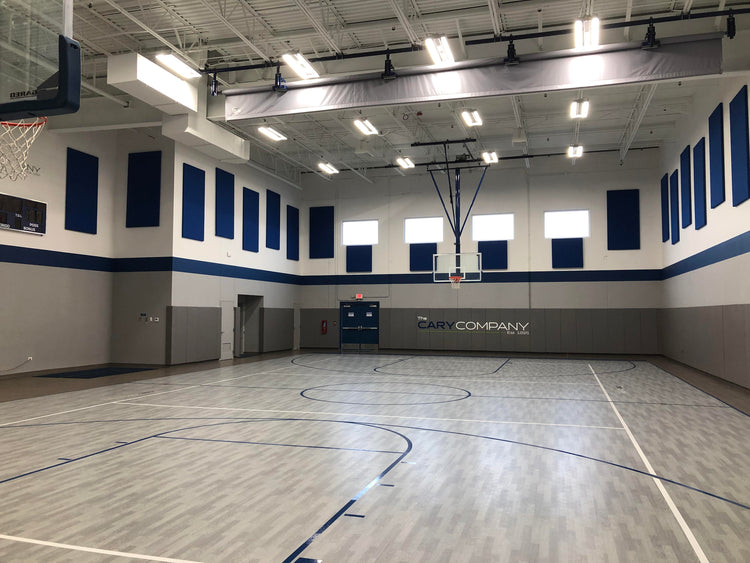
What works for a gymnasium?
Quick answer: Large 2″ or 4″ panels on walls + ceiling clouds or drop-in tiles. Gyms are huge, hard-surfaced, and need a lot of square footage of treatment. Target 25-35% surface coverage minimum. Class A fire rating documentation typically required.
Gyms are big, echoey, and high-impact (literally - balls hit the walls). Use:
- Large 2″ panels (4'×8' single piece) on walls - more sqft per panel = fewer seams
- Ceiling clouds or drop-in tiles overhead
- Impact-resistant Homasote-based panels in zones where balls hit walls
- Class A fire rated assemblies for code compliance
Gym installs are typically 100+ panels and quoted as a full project. Submit a Free Room Analysis with floor plan or photos.
Related products: Large 2″ Acoustic Panels · Acoustic Ceiling Tiles · Homasote Sound Barrier Panels
What works for a church or worship space?
Quick answer: Speech intelligibility is the priority. Treat rear wall + side walls + balcony fronts with 2″ panels. Avoid over-treating the music end of the sanctuary - choirs and live bands need some natural reverb. Custom art panels and PET felt work well for design-conscious sanctuaries.
Churches have a unique challenge: speech needs clarity (pastor, A/V, AV/video), but music (choir, worship band) often needs some natural reverb. Treat asymmetrically:
- Rear wall behind congregation: 2″ panels or 4″ panels to kill late reflections that hurt speech intelligibility
- Side walls in the back third: 2″ panels for first-reflection control
- Balcony fronts: panels to stop sound bouncing back to the platform
- Front platform area: leave more reflective for music, or use diffusers instead of absorbers
- Custom art panels with church imagery / scripture for design-forward sanctuaries
Related products: 2″ Acoustic Panels · 4″ Acoustic Panels / Bass Traps · Custom Acoustic Art Panels
What works for an office or video-call setup?
Quick answer: 2″ panels behind the camera position and on the wall behind you (visible on camera) + a panel or two on the ceiling above the desk. 1″ panels also work for office spaces if budget is tight. PET felt panels look great in modern offices.
Video calls and remote-meeting audio depend on a clean, dry room sound. Even a single panel placed behind the camera (where it shows on screen) makes a measurable difference.
Minimum office setup:
- 1-2 panels on the wall behind you (in camera frame)
- 1-2 panels on the wall behind the camera
- Optional: ceiling panel above the desk for comb-filter control
For open-office or shared spaces: PET felt panels or ceiling tiles drop background chatter without dominating the design. Custom art panels can also do double duty as branded decor.
Related products: 2″ Acoustic Panels · PET Felt Acoustic Wall & Ceiling Panels · 1″ Acoustic Panels · Custom Acoustic Art Panels
What works for classrooms and schools?
Quick answer: 2″ panels on walls + drop-in ceiling tiles (especially PET felt for kid safety). Classrooms are speech-intelligibility-driven. Class A fire rating typically required by code; PET felt is dust-free and fiberglass-free for sensitive students.
Classrooms have a clear acoustic priority: students need to hear the teacher. Hard surfaces (drywall, tile, large windows) plus 25+ kids = chaos. Treatment is straightforward:
- PET felt drop-in ceiling tiles for grid ceilings - no fiberglass, no formaldehyde, dust-free
- 2″ wall panels at speech-height on the rear wall and one side wall
- Class A fire documentation provided for school code compliance
- Tax-exempt orders welcome (district / school / non-profit)
For multi-room school projects, submit a Free Room Analysis with the building plan and we will quote the rollout.
Related products: PET Felt Acoustic Wall & Ceiling Panels · 2″ Acoustic Panels · Acoustic Ceiling Tiles
What works for a home theater?
Quick answer: Heavy treatment for critical listening: corner bass traps (4+) + 2″ panels at first reflections + 4″ rear-wall panels + ceiling cloud above the seating. Target 40-50% surface coverage. Add diffusion on the rear wall if the room sounds too dead.
Home theater is one of the most demanding spaces - low-frequency control is critical for movie-soundtrack impact:
- 4+ corner bass traps (every vertical corner, plus front and rear floor corners if possible)
- 2″ panels at first reflection points on side walls (between speakers and listening position)
- 4″ panels on the rear wall behind the seating
- Ceiling cloud directly above the listening position
- Optional: quadratic diffusers on the rear wall to scatter rather than absorb
Custom art panels work great here - movie poster art, branded film panels, or your own photography to make the room personal.
Related products: Corner Bass Traps · 2″ Acoustic Panels · 4″ Acoustic Panels / Bass Traps · Custom Acoustic Art Panels
What works for a hifi listening room?
Quick answer: Critical listening rooms need precise, symmetric treatment: 4-6 corner bass traps + 2″ first-reflection panels + 4″ rear-wall panels + ceiling cloud. Symmetry left-to-right matters. Add diffusion on the rear wall to keep the room "alive."
Hifi listening rooms are the most precision-driven application we treat. Decisions here affect mix and listening accuracy on every track played. Key principles:
- Symmetry: identical treatment on left and right walls
- First-reflection control on side walls between speakers and listening position
- Aggressive corner bass control (every vertical corner)
- Rear-wall: half-absorbed (4″ panels) and half-diffused (quadratic diffusers) to keep depth without comb filtering
- Ceiling cloud above the listening triangle
Hifi rooms benefit from a real measurement pass after install (REW + a measurement mic). Treatment alone gets 80% of the way; measurement closes the last 20%.
Related products: Corner Bass Traps · 2″ Acoustic Panels · 4″ Acoustic Panels / Bass Traps
Care, Cleaning & Longevity
How do I clean acoustic panels?
Quick answer: Vacuum with a soft brush attachment for routine dust. For spot stains, blot with a damp cloth and mild soap (do not soak). Microsuede and Burch Prime Time are both spot-cleanable. Avoid bleach or harsh solvents. PET felt panels can be vacuumed and lightly damp-wiped.
Routine maintenance: vacuum monthly with a soft brush attachment. Dust naturally settles on horizontal panels (ceiling clouds especially) - keep them clean and they will look new for years.
Spot cleaning:
- Damp cloth + mild soap (Woolite, Tide Free) for most stains
- Blot, do not rub - rubbing can fuzz the fabric
- Test on a hidden corner first
- Let dry completely before judging the result
Avoid: bleach, harsh solvents, steam cleaners, excessive water. These can damage the fabric face or wick into the core.
For deep cleaning (smoke, kitchen grease, mildew): re-wrap is rarely cost-effective. Replacement panels matched to your existing fabric are usually the right call. See our fabric replacement Q&A.
Will the fabric fade or wear?
Quick answer: Burch Fabrics Prime Time and Guilford of Maine FR701 are both colorfast and rated for commercial use. Burlap and microsuede are also stable indoors. UV-direct sunlight will eventually fade any fabric - keep panels out of direct sun where possible.
Our standard commercial fabrics (Burch Prime Time, Guilford FR701) are designed for high-use commercial environments and are rated for years of indoor use without noticeable fade.
Fade factors:
- Direct sunlight (UV) accelerates fade on any fabric over time
- Some saturated colors (deep reds, dark blues) show fade earlier than neutrals
- Indoor lighting (LED, fluorescent) has minimal fade impact
If your install is in a sunny lobby or window-facing room, consider neutral colors or PET felt (which is also UV-stable).
How long do panels last?
Quick answer: Decades of indoor use is normal. Our panels are built for commercial environments - the fiberglass core does not degrade, the wood frame is stable, and the standard commercial fabrics resist fade and wear. Expect 20+ years of service in normal indoor conditions.
Acoustic performance does not degrade over time - the core absorbs the same as it did on day one. What ages is the fabric face (fade, dust, occasional spot stain) and that is replaceable on a case-by-case basis.
Our panels are in restaurants, churches, schools, and studios that have been running for 15-20 years and the panels are still working. The fabric may have aged visually but the acoustic function is intact.
We offer a limited lifetime warranty on craftsmanship.
Are panels pet-safe?
Quick answer: Yes - mounted panels are pet-safe. The acoustic core is fully enclosed in fabric so pets cannot reach the fill. Mount above pet height in homes with chewing dogs or scratching cats - or use PET felt panels which are non-fiberglass.
Pets in studios, podcast rooms, and home offices are common. Some practical tips:
- Mount panels above pet reach (typically 4-5 feet for dogs, higher for cats)
- Avoid floor-mounted panels in chewing-prone households
- For cat households, microsuede and burlap can attract claws - Burch Prime Time has tighter weave
- For dust-sensitive pets, PET felt panels are dust-free and hypoallergenic
Related products: PET Felt Acoustic Wall & Ceiling Panels · 2″ Acoustic Panels
Are panels antimicrobial / dust-free?
Quick answer: Standard fabric panels are inherently low-dust because the core is fully enclosed. PET felt panels are dust-free and naturally hypoallergenic. Antimicrobial fabrics are available on request for healthcare and food-service applications.
Dust on panels is from room air settling on the fabric, not from the panel itself. Vacuum monthly to keep panels clean.
For healthcare, food service, or dust-sensitive applications, ask about:
- Antimicrobial fabric options (Crypton, treated commercial fabrics) on request
- PET felt panels for inherently low-dust, hypoallergenic environments
- Wipeable / waterproof fabric options for kitchen-adjacent installs
Do you offer antimicrobial fabric for acoustic panels?
Quick answer: Yes, on request - antimicrobial fabric options (Crypton and treated commercial fabrics) for healthcare, food-service, and high-touch environments. Quoted per project; not a standing stocked option. Submit a Free Room Analysis with your application and we will recommend the right fabric and provide treatment documentation.
For healthcare facilities, food-service operations, locker rooms, daycare centers, and any high-touch commercial environment, we offer antimicrobial fabric options on request:
- Crypton fabrics: permanent antimicrobial + stain resistance + moisture barrier. Common spec for healthcare and senior-living projects.
- Treated commercial fabrics: antimicrobial-treated versions of Burch and Guilford lines for projects that need a specific color but with antimicrobial protection.
- PET felt panels: the polyester is naturally hypoallergenic and dust-free, which solves a related concern in pediatric and dust-sensitive applications even without an explicit antimicrobial treatment.
Antimicrobial fabrics are quoted per-project and not listed on standard product pages. Submit a Free Room Analysis with your application (healthcare type, food-service zone, etc.) and we will recommend the right fabric and supply treatment documentation for code review.
My panels are falling off the wall - what should I do?
Quick answer: Almost always one of three causes: wrong anchor for the wall type (drywall anchors instead of stud-hits for heavy panels), Command Strips overloaded for the panel weight, or hardware not fully engaged. Stop using the panel until it is properly secured - falling fabric panels are not dangerous but a 4″ bass trap landing on a console is. Call (888) 923-5777 with the panel size, wall type, and hardware you used and we will diagnose.
The three usual causes:
- Wrong anchor for wall type - hollow-wall anchors rated for 5 lbs holding a 12-lb panel. Hit a stud where possible, or use anchors rated for 2x the panel weight as a safety margin.
- Command Strips overloaded - Command Strips work on lighter panels (1″ or smaller 2″), not on full 4'×8' fabric-wrapped or 4″ bass traps. Use Z-clips for anything bigger than ~8 lbs.
- Hardware not fully engaged - with Z-clips, the panel cleat must fully hook over the wall cleat. Visual check: panel sits flush, no gap.
Fix it:
- Take the panel down (do not let it fall)
- Check the panel weight - written on shipping label or call us
- Check what you anchored into (drywall only? stud? concrete?)
- Match anchor + hardware to that combo
- For Z-clips: order our installation kit if you used something else
Call (888) 923-5777 with the panel size, wall type, and what hardware you used. Most "falling off" issues are 5-minute fixes once we know the situation.
Can acoustic panels get wet, and how do they handle humidity?
Quick answer: Normal room humidity is fine. Do not install them in wet areas like bathrooms, saunas, or exposed outdoors.
Brief moisture, such as a spill or everyday humidity, will not damage our panels. The fiberglass core is moisture resistant and normal humidity from your HVAC or local climate is no problem. What you should avoid is installing standard panels in genuinely wet environments like bathrooms, saunas, or exposed outdoor areas. If you need panels for a damp or outdoor space, see Do you make outdoor acoustic panels? for the right product.
Our Shop & Process
Where are panels made?
Quick answer: Lombard, Illinois. We print, cut, wrap, and assemble in-house. Made in USA.
We are a working shop in our USA shop. Every panel is custom-built here:
- Print custom artwork on our large-format printer
- Cut wood frames and fiberglass cores to spec
- Wrap fabric by hand
- QC and ship
Pickup is by appointment - call (888) 923-5777 to schedule.
How long has the company been around?
Quick answer: Acoustic Sound Panels has been operating since 2012. We are an independent, owner-operated US manufacturer - not a reseller, not a drop-shipper.
14+ years of operation. The shop runs on the strength of repeat customers - studios, restaurants, contractors, integrators, and schools who have come back again because the product works and the lead times hold.
Do you offer installation?
Quick answer: Our panels are made to install yourself or with your own contractor. Every order ships with mounting hardware and illustrated instructions, and we work directly with your contractor, AV integrator or facilities team on layout and mounting.
Most of our customers self-install (residential) or work with their existing contractors and AV integrators (commercial). Here is how we help either way:
- Your existing team: we work directly with AV integrators, GCs, and facilities teams. Send us your contact and we will coordinate.
- Chicago-area projects: we sometimes coordinate install ourselves through trusted local installers. Call to discuss.
What we always supply:
- Panels custom-built to spec
- Mounting hardware (Z-Clip Installation Kit or your specified hardware)
- Illustrated installation instructions
- Phone support during install if you hit a snag
Questions about mounting on your walls or ceiling? Submit a Free Room Analysis with your project details, or call (888) 923-5777.
Who is this FAQ for?
Quick answer: Anyone trying to understand whether acoustic panels will fix their room and what to order. Compiled from real customer questions over 14+ years of operation.
The questions on this page come from real customers - phone calls, chat conversations, and emails over the past 14 years of operation. If your question is not here, submit a Free Room Analysis with the specifics and we will answer.
Do you have retail store locations?
No. AcousticSoundPanels.com is online only - we do not run a retail showroom. Every panel is custom built to order at our Chicago-area fabrication facility and shipped direct. If you want to see and feel the materials before ordering, we recommend a swatch sample (the sample cost is credited back when your order is placed within 14 days of the swatches arriving). For project help, call (888) 923-5777 or submit a Free Room Analysis.
How can I contact customer service?
Three ways to reach us. Phone: (888) 923-5777. Live chat: the bubble at the bottom right of any page on acousticsoundpanels.com. Web form: the contact form at acousticsoundpanels.com/pages/contact-us, which routes straight to our team. For room-specific advice, the fastest path is the Free Room Analysis form at acousticsoundpanels.com/pages/free-room-analysis.
Can I pick up my order locally?
Quick answer: Yes, by appointment at our Lombard, Illinois location. We do not have a public showroom, so please arrange pickup with us first.
Yes, by appointment at our Lombard, Illinois location. We do not have a public showroom, so please arrange pickup with us first. Online orders over $349.99 also ship free for panels 24″×48″ and smaller.
Did not find your question?
Tell us about your space and we will recommend a layout, sizes, and fabric.
Free Room Analysis Call (888) 923-5777